
FOR IMMEDIATE RELEASE
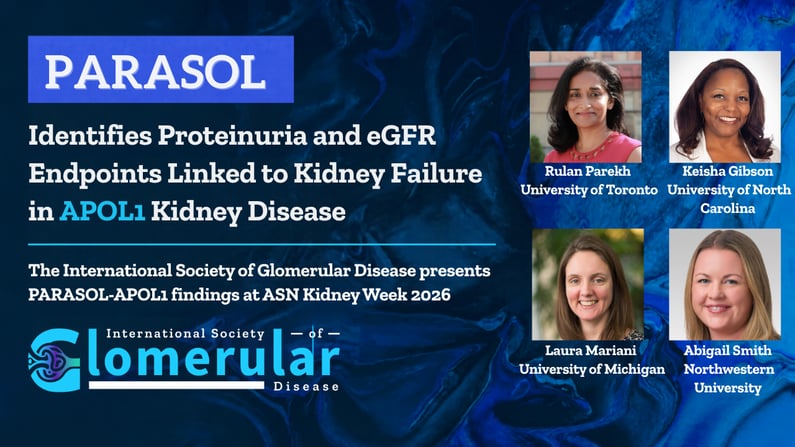
PARASOL Identifies Proteinuria and eGFR Endpoints Linked to Kidney Failure in APOL1 Kidney Disease
The International Society of Glomerular Disease presents PARASOL-APOL1 findings at ASN Kidney Week 2026
Florence, MA, October 24, 2026 — The International Society of Glomerular Disease (ISGD) announced results from PARASOL-APOL1 (Proteinuria and Other Biomarkers as Endpoints for Clinical Trials in Kidney Disease – APOL1). This multi-stakeholder initiative evaluates longitudinal changes in proteinuria and estimated glomerular filtration rate (eGFR) as clinical trial endpoints for people carrying two APOL1 high-risk alleles. The findings were presented at a public scientific meeting in Arlington, Virginia, on September 23, 2026. The meeting brought together nephrologists, biostatisticians, trialists, patients, advocates, industry sponsors, and regulators from the U.S. Food and Drug Administration (FDA) and other regulatory agencies.
APOL1 high-risk variants, carried by an estimated 5–6 million Americans, predispose people to kidney disease from multiple causes and can lead to progressive kidney disease. There is a paucity of longitudinal studies examining the natural history and progression of chronic kidney disease in this patient population, which hinders progress in developing targeted therapies. Building on the prior successful PARASOL-FSGS project, the goal of PARASOL-APOL1 is to establish surrogate endpoints that make therapeutic trials efficient and feasible. Collaboration with the FDA was facilitated by ISGD’s formal Public-Private Partnership with the FDA’s Center for Drug Evaluation and Research (CDER). PARASOL partners include NephCure, the National Kidney Foundation, the Kidney Health Initiative, as well as leadership from the University of Michigan (as the Data Coordinating Center and their biostatisticians) ) and biostatistician leadership from Northwestern University. Data was presented at the American Society of Nephrology’s Kidney Week in Denver, in the form of abstracts and during the session entitled Clinical Trials in Glomerular Disease: Can We Still Deliver Them?
Key Findings
There are limited longitudinal data available over 5 years in most studies. Data were collected from established cohort studies, registries linked to electronic medical records, and from centres of clinical excellence in management of glomerular disease. The analysis is lead by Abigail Smith, PhD, Associate Professor of Biostatistics, Department of Preventive Medicine, Northwestern University Feinberg School of Medicine. Dr. Smith emphasized that “these findings provide unique insight into the natural history of APOL-1 kidney disease and epidemiologic support for potential clinical trial endpoints. We look forward to adding datasets that will allow us to increase precision in key subgroups and collaborating on global validation of these results.”
This preliminary analysis included 879 children and adults with two APOL-1 high-risk alleles. Chronic kidney disease was attributed to hypertension (42%), glomerulonephritis (37%), diabetes (16%). Participants had a median baseline eGFR of 45 mL/min/1.73 m² and a median follow-up of 64 months. During follow-up, 41% progressed to kidney failure. Key points included:
- High prognostic value of proteinuria: Five-year kidney failure-free survival fell from 92% in those with UPCR <0.1 g/g at baseline to about 60% in those with UPCR ≥1.0 g/g. Annual eGFR loss was about 1 mL/min/1.73 m²/yr at the lowest proteinuria level and 7 mL/min/1.73 m²/yr at UPCR ≥3.5 g/g.
- Disease progression by eGFR slope: Among 585 participants with reduced kidney function, eGFR declined by about 3.3 mL/min/1.73 m² per year over 24 months. Each 1-unit faster decline was associated with a 31% higher risk of kidney failure (adjusted HR 1.31; 95% CI 1.25–1.37). Slope variability was about 40% lower than in an all inclusive FSGS population, which favors efficient trial design.
- Disease progression ≥40% eGFR decline: A decline of 40% or more at 24 months was associated with a more than 11-fold higher risk of kidney failure (adjusted HR 11.51; 95% CI 7.65–17.32).
- Proteinuria response: responses at 12 months were associated with significantly lower risk of kidney failure:
- complete remission, defined as UPCR <0.3 g/g (adjusted HR 0.22; 95% CI 0.12–0.41)
- a decline in UPCR of 50% or more (adjusted HR 0.32; 95% CI 0.21–0.47)
- Disease progression with change in proteinuria and eGFR: Both proteinuria endpoints at 12 months were associated with slower eGFR decline at 24 months, by about 3.2–3.6 mL/min/1.73 m² per year. Findings were broadly consistent across age, baseline eGFR, baseline proteinuria, and clinical subgroups with sufficient sample size.
- Principal Investigators: Keisha Gibson (University of North Carolina), Laura Mariani (University of Michigan), Rulan Parekh (University of Toronto)
- Senior Advisors: Daniel Gale (University College London), Matthias Kretzler (University of Michigan)
- Statistical Lead: Abigail Smith (Northwestern University)
These data support proteinuria- and eGFR-based endpoints for therapeutic trials in APOL1-associated kidney disease. We will continue to collect data globally to enrich the dataset and represent the global population at risk. Additionally, there will be validation in regional data from the US, UK and west Africa.
We do not yet have sufficient sample size to assess important subgroups including those infected with HIV or with lupus or Sickle Cell disease. These will be included in future analyses and will require stratified analyses.
“The PARASOL-APOL1 project is an outstanding example of the nephrology community coming together to share data and answer important questions about the relationship between eGFR and proteinuria with long term risk of kidney failure. These analyses and the multidisciplinary discussions are critical to better trial design and interpretation of results” said Laura Mariani MD, Professor of Medicine, University of Michigan.
Why This Matters
Validated surrogate endpoints can transform drug development. Before endpoint methods were established in IgA nephropathy in 2016, no therapies were approved for it; six are now FDA-approved. These preliminary data provide critical information for regulators as they consider potential endpoints for treatments in those carrying 2 high-risk APOL1 alleles.
PARASOL-APOL1 Investigators
About the International Society of Glomerular Disease
ISGD is a professional nephrology society founded to build the future of glomerular medicine. Its mission is to unite a global community to connect, educate, transform, and support glomerular disease research and medicine to improve patient care. For more information, visit www.is-gd.org.
Media Contact
Starlene Chang
Marketing Manager, International Society of Glomerular Disease
star.chang@is-gd.org
COMMENTS